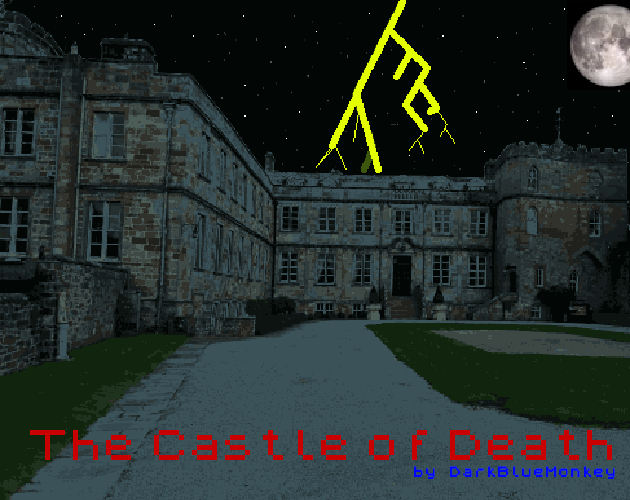
The Castle of Death was my entry into the Halloween Adventuron Game Jam. It's a text adventure with graphics for most locations, and which features the most complex logic I'd yet done in an Adventuron game. |
Plot
You awaken on the rug in a study of a mansion. You have no memory except that you shouldn't be there, but you can't remember why. You know something bad has happened, but you're not sure if it was your fault. You have to race against the clock, and make sensible detective decisions, to solve the mystery before you're either captured or run out of town.
Complexities
The game was the largest I'd done so far, with over 60 unique locations. The house and its grounds are 'seeded' with clues, but the interesting thing about the game is that there are a number of possible perpetrators. You need to search the house and grounds, look for clues, and trace them back to find the culprit. Then you need to to and hand yourself into the Police with your evidence. Get it wrong, and accuse the wrong person, and it's all over for you...
Concept
The concept came to me while I was playing an online version of Cluedo (Clue in the USA). I liked that the game randomized the murderer and the murder weapon, and then you had to use logic and cunning to work out the chain of events. I also remembered a very cool old play called "An Inspector Calls" where a young girl dies by her own hand, and there's a house full of people who could have driven her to it. It's unclear who actually dealt the "final straw" which made the girl commit suicide, but although it seems that that's the point of the play, in the end, the point is to show that, in their own ways, they ALL killed her. I liked the ambiguity, and that anyone could be the villain.
So, when I was putting together the game for the game jam, I knew it had to be a creepy castle (where better for a Halloween Game?), and I knew there had to be a murder, and I wanted it that the player couldn't look up an answer. They could potentially look up what all the different potential answers were, but they needed to actually play it to find out.
Late in the development I realised that the game was pretty tricky, so I added a fully intelligent help system, similar to some Infocom games. It tracks all the things you've done (using the notebook feature), and when you type "HELP" it looks in the notebook, sees what you've done, and then can give a clue what you're supposed to do next.
Building the Game
Create a starting area to set the scene
The first thing to do was to map out the house. Almost all houses in text adventures are aligned East-West with an entrance on the south side, i.e. you enter by going North. So I laid out a simple two-floor house, with two wings, a west wing and an east wing.
I wanted the player to wake up on the upper floor, and for much of the suspense to be set up there. They kind of know that as long as they're on the upstairs, they're safe. I wanted a butler or footman to be patrolling the downstairs too, so jotted down some ideas about how to telegraph footsteps in a turn-based text adventure game.
I laid out the wings with one for the wake-up area, a study, one an abandoned nursery (they're always creepy), a bedroom for the freshly deceased, and a bedroom which I can use for setting out one of the possible murderers. I created stub descriptions, then created a simple lower-floor containing a lounge, a waiting room, hallway, feasting hall, servants' quarters and kitchens, again East-West, connected to the upper floor by a servants' stair and the main stair.
Then I placed some placeholder "gardens" outside, and started building the logic!
Next, I chose names, jobs, genders and a motives for four murderers. I had an overarching story which could be told in four parts.
Create the Logic
Creating elaborate games seems to be Adventuron's raison d'etre. I drew a crude diagram of the house, and picked four possible "entry points" for a murderer. I then picked four possible "murder weapons", and then played "what if" in my mind. I traced the killer's movements through the house, adding a room here, or a detail there, up to the study, writing down all the clues the player might find.
Each of the "paths" that the murderer might take was turned into a "zone", so there were four zones. Next, I created an "examine" subroutine that performed all the logic for if a player was hunting for clues. If the player hunted in the right zone for the random entry point, they'd get a suitable message to help the player follow the clues. So long as they stayed in the zone, they got the trail.
Next, I matched an entry point to a murderer, and for each murderer, a murder weapon was chosen.
Fleshing out the map
Next, I expanded out the map. I drew a simple plan of the castle, some woodland and a small one-road town. I then set about creating all the locations for the map, and tweaked a few links to make it flow better. After a few hours, I had most of the town created.
The one location that ended up being heavily trimmed (or cut) was the hospital. In my original plan, I had one of the murderers be a doctor who was moonlighting as a graverobber / organ thief, so I had a hospital that you needed to steal a doctor's badge to get into the upper floor and catch the doctor in the act. But as the deadline for the Jam drew closer, I had to scrap "murderer D (Doctor)", and it got replaced by a duckpond with an angry old lady, which was far quicker to code.
Once I'd built out the map, the gardens of the castle needed connecting up. I continued the "what if", and selected four entry-points which could be "open" or "closed". the game would open one of the entry points, depending on the killer and method. So the player would now track back, getting realistic clues out of the house, over the grounds and to a border point. This, then led back to the town, and by the time the player got to the town, she should have enough clues to either march straight into the police office, or to go do some interrogating.
The interrogations
I wanted the possible murderers to be in the town, so I put them in various locations. You can go up to them, quiz them on their whereabouts, and ask them about the other suspects. If the player had totally failed to find the clues in the house, then what I wanted was for the player to have a "second bite of the pie". I played the night of the murder through in my head four times, one for each murderer, and thought "what would the other three see?", then "what would the murderer say?". So I created a big map of who would see whom, and what they'd say they'd seen them doing.
I coded this up as an "ask x about y" subroutine, which was a giant if/then tree. Depending on who the murderer was, the four would claim to have seen two of the others, and would give specific feedback on what they saw. If the player is cunning and she'd written down what they'd seen, she'd find that one of the stories didn't match up. There'd be two other sightings that would disagree with it.
The notebook
All good detectives have a notebook. I wanted the player to have one too. So I created a multi-page "notebook" that would get slowly filled with evidence. Each page was on a topic, like murderer, weapon, motive, alibis and so on. As the player found clues, they'd get entered into the notebook.
Behind the scenes, the game keeps a track of everything the player's done. This is given a hidden "score". When the player turns up at the police station, they have to "show notebook". They're then asked to name the murderer. If they get the murderer right, and they've collected enough (about half) of the clues, the police will believe the player.
If the player names the wrong person, but the notes in the book are good enough, the player gets a slightly less good outcome. If the notes are inadequate, and the player tries a hail mary and just names someone, they get a slightly worse again outcome.
If they rock up at the police station, name the wrong person, have inadequate notes, then it's curtains for the player, the police slap on the cuffs.
Details, details
So, putting all that together took quite a long time. I was in danger of missing the deadline on the jam, but the game still didn't quite feel finished. That weekend I'd booked a mini break at Appleby castle in the north of England for the family, and had the presence of mind to take my camera. While we were there, I ran around taking photos of the outside and inside. I downsampled them to look old school, and loaded them into the game at night while we were away.
Finally, I added a few more little details, like the fact the player was covered in blood, and if they walk into the police station (or get seen), it's not a good result. I added a few other timed events, like the butler patrolling downstairs, the police will eventually be called to the house when the butler finds the body, and a few other little hidden things here and there.
In the end, I'd spend a huge amount of time on it, and had to clip out a LOT of locations and logic to get it into the Jam on time. But I'm immensely proud of it. It's not a perfect game, but it's a real challenge for anyone to solve the clues, and if the player plays again, they get a different random murderer. If they play the game through two or three times (it's MUUUUUUUUUUUCH faster once you know the two or three items you have to grab, and know the routine for checking for clues), then an overarching story emerges, and the player will figure out the full story of the Castle of Death
Reception
The game was generally well recieved. some people said it was a little too complex, while others critised its size (it is BIG compared to other entries). Overall, the images and the atmophere seemed to carry it, and while I don't think it won, that went to The Curse of Rabenstein, a very cool (now published on the ZX Spectrum Next) game, which did deserve to win, I'm still quite pleased with how it turned out.